Most conversations about bio-based insulation start with carbon and thermal performance. Those matter, and they are central to what we do at Hempitecture. But a healthy building also has to be a quiet one. How well do hemp-based materials control noise between rooms, tame echo inside a space, and soften footsteps from the floor above?
To answer that with data rather than marketing, we worked with Leftear, a UK-based acoustic engineering firm focused on decarbonizing acoustic design. Leftear tested and modeled five Hempitecture product configurations using laboratory impedance-tube measurements, ISO 12354 modeling, and impact-sound R&D testing on real floor structures.
This article summarizes what that work shows, what it does not show yet, and how architects and specifiers can use the results responsibly.
Three acoustic problems, three material roles
“Soundproofing” covers several different problems. Each one calls for a different material role.
| Acoustic problem | What is happening | Hempitecture material role |
|---|---|---|
| Cavity resonance (airborne sound through walls and ceilings) | Sound energy builds up in the air space between wall or ceiling layers | HempWool as a porous cavity absorber |
| Room reverberation | Sound reflects off hard surfaces inside a room, causing echo and poor speech clarity | PlantPanel as an exposed absorber, subject to product development and full-scale testing |
| Footfall and impact noise | Footsteps and dropped objects excite the floor structure and radiate into the room below | FiberPad as a resilient underlayment |
The acoustic metrics, briefly
- Absorption coefficient (α): The fraction of sound energy a material absorbs at a given frequency, from 0 (fully reflective) to 1 (fully absorptive).
- NRC (Noise Reduction Coefficient): A single-number average of absorption across speech frequencies, formally measured in a reverberation room under ASTM C423.
- STC (Sound Transmission Class): A rating of airborne sound isolation for a complete wall or floor assembly, not a single material.
- IIC and ΔIIC: IIC rates impact sound isolation of a floor-ceiling assembly. ΔIIC describes the improvement a floor covering or underlayment adds to a reference floor.
The key point: absorption and NRC describe materials. STC and IIC describe assemblies.
Material testing: how much sound do the products absorb?
Leftear measured normal-incidence absorption in an impedance tube following ISO 10534-2, testing three specimens per product. The products tested were:
- 2″ HempWool at 2,018 g/m² and 2,347 g/m²
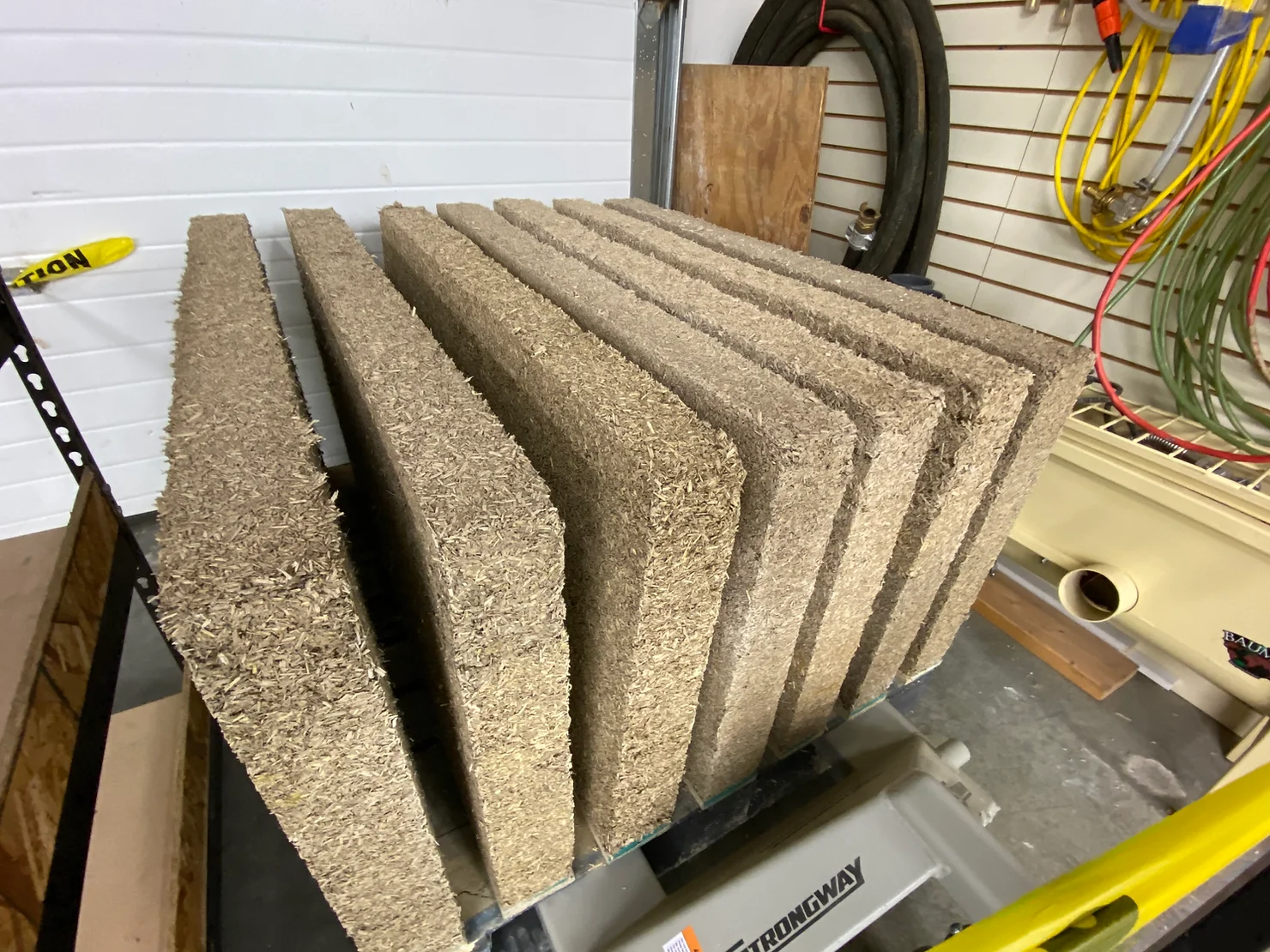
- 2″ PlantPanel at 5,671 g/m²
- 2″ PlantPanel X at 5,731 g/m²
- 0.6″ FiberPad
| Product | Average absorption coefficient | Indicative NRCn |
|---|---|---|
| 2″ HempWool, 2,018 g/m² | 0.51 | 0.55 |
| 2″ HempWool, 2,347 g/m² | 0.62 | 0.69 |
| 2″ PlantPanel, 5,671 g/m² | 0.67 | 0.73 |
| 2″ PlantPanel X, 5,731 g/m² | 0.71 | 0.77 |
| 0.6″ FiberPad | 0.29 | 0.24 |
The denser HempWool reached 0.90 at 1,000 Hz, 0.97 at 1,250 Hz, and 0.98 at 1,600 Hz. PlantPanel and PlantPanel X stayed above 0.90 across much of the 800 to 1,600 Hz range and began absorbing strongly at lower frequencies than HempWool.
Important: NRCn is an indicative value derived from impedance-tube data. It is not an ASTM C423 NRC, which is measured on larger samples in a reverberation room with a defined mounting. Use these values to compare materials, not as published product ratings.
Walls: hemp insulation performs like conventional insulation in the cavity
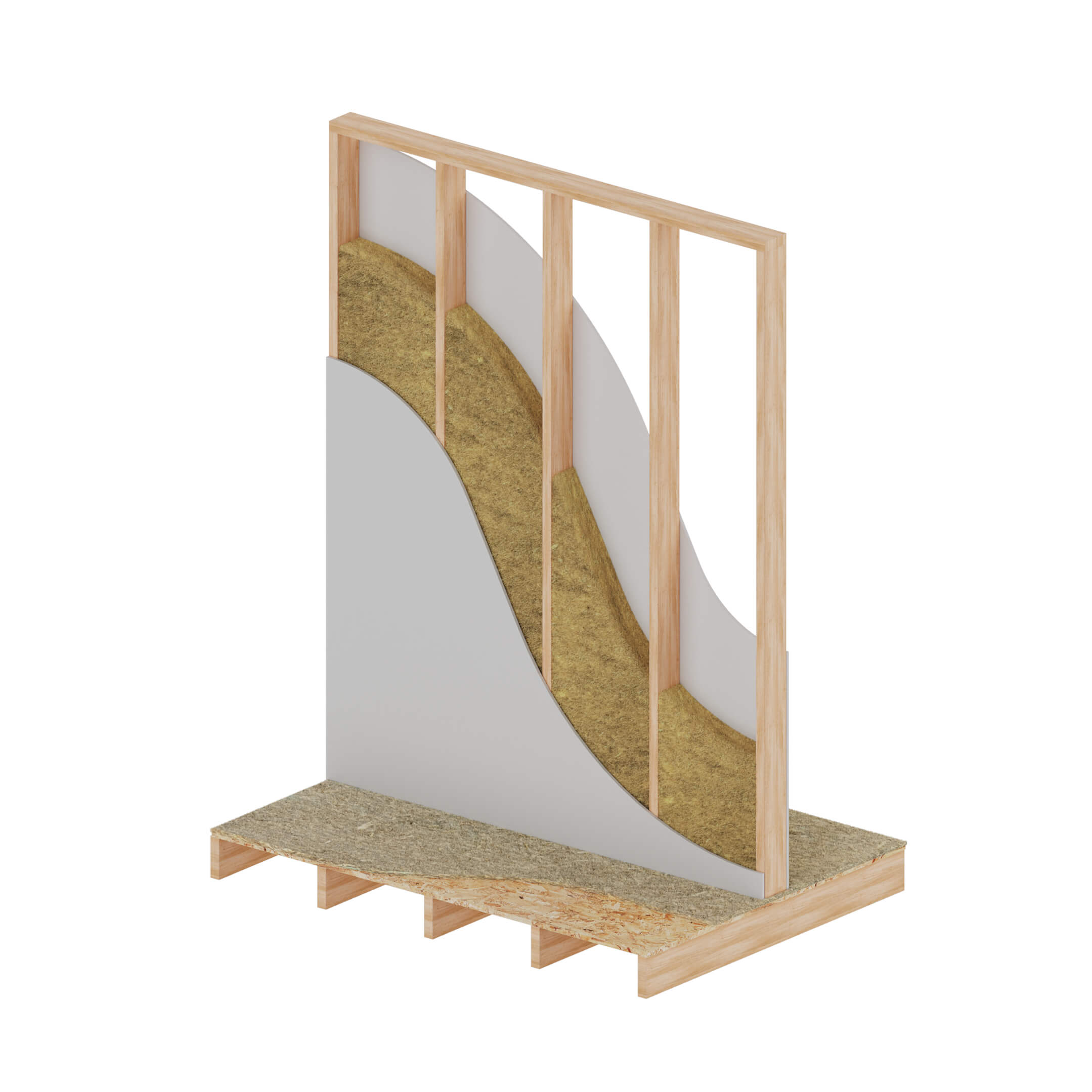
Inside a wall, insulation damps resonance in the air cavity and keeps the two sides of the wall from behaving like a drum. Leftear benchmarked 2″ HempWool (2,347 g/m²) and 2″ PlantPanel against 2″ Knauf Earthwool (16 kg/m³) in an ISO 12354 model of a framed partition targeting STC 50. The wall used 90 mm C-studs with two layers of gypsum board on each side (1/2″ Type C and 5/8″ Type X).
- All three reached STC 51. HempWool, PlantPanel, and the conventional mineral wool produced the same modeled rating.
- PlantPanel showed a marginal low-frequency advantage. With its higher surface mass and semi-rigid structure, PlantPanel placed flush against the inner board gave slightly better modeled insulation in the 80 to 160 Hz bands.
The lesson for specifiers: once a suitable porous absorber fills the cavity, the rating is controlled by the rest of the assembly. Mass layers, cavity depth, and framing connections drive STC. To get the most from a hemp-insulated wall:
- Fill the cavity consistently, without gaps or compression.
- Provide adequate mass in the facing layers.
- Use resilient or separated framing where higher isolation is needed.
- Seal the perimeter and all penetrations.
- Control weak points such as doors, glazing, ducts, and outlets.
- Detail wall, floor, and ceiling junctions to limit flanking.
Modeled low-carbon wall assemblies
Leftear also modeled several bio-based wall types combining Hempitecture products with clay board (ClayTec), plywood, and decoupled framing. These are calculated values, not tested ratings:
- 5″ internal wall, modeled STC 45: 3.5″ timber studs with 2″ HempWool (2,347 g/m²), faced with 3/4″ plywood and 3/4″ ClayTec board.
- 5.875″ acoustic wall, modeled STC 50: 3.5″ BioStud framing with 2″ HempWool, 3/4″ plywood, and ClayTec boards (3/4″ and 7/8″) on opposite faces.
- 7″ high-performance wall, modeled STC 58: Dual 2″ layers of PlantPanel X in a decoupled double-stud or connector assembly with plywood and ClayTec facings.
- 12″ masonry wall upgrade, modeled STC 65: An existing 6″ masonry wall with directly fixed 3.5″ PlantPanel, an airtight membrane, 3.5″ framing, and two layers of 0.5″ Type C gypsum board.
Room acoustics: PlantPanel as an exposed absorber
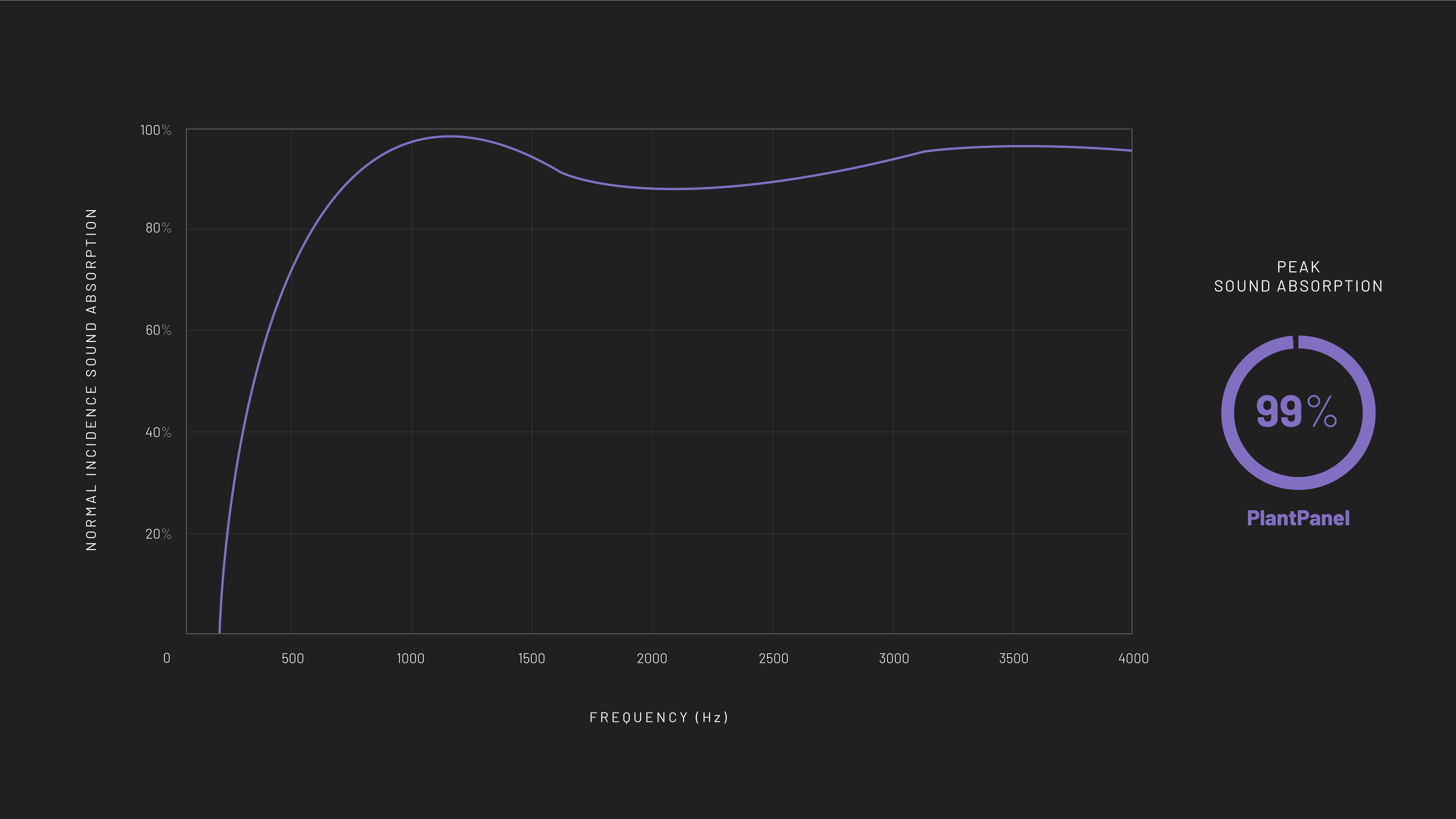
Conventional mineral fiber usually has to be hidden behind drywall or wrapped in fabric. PlantPanel has a natural texture that can be left exposed, and PlantPanel X reached an indicative NRCn of 0.77 in tube testing. That makes it a promising starting point for room treatments, but it is not yet an ASTM-rated acoustic panel.
Leftear identified several development paths:
- Wall panels mounted with an air space behind them, with offsets of at least 2 inches
- Suspended ceiling clouds or rafts
- Framed panels with an acoustically transparent finish
- Perforated or slotted facings
- Density and thickness changes to improve absorption around 160 to 500 Hz
Before PlantPanel can be specified as a rated absorber, each configuration needs a defined geometry, facing, and mounting, followed by ASTM C423 testing.
Floors: CLT and timber need a full assembly
Bare cross-laminated timber is not a complete acoustic floor. It is relatively light and stiff, so footfall transmits readily, especially at low frequencies.
Published research supports a build-up approach. Vardaxis et al. (2022) evaluated twelve configurations over 180 mm CLT and found that resilient layers, floating floors, and suspended ceilings delivered the largest gains, with improvements of up to 22 dB for airborne sound and 32 dB for impact sound depending on the build-up. Ha et al. (2023) found that simply increasing CLT thickness had low cost-effectiveness for impact sound and recommended resilient buffer layers or hybrid floors instead.
FiberPad impact sound results
Leftear ran R&D impact-sound measurements on 0.6″ FiberPad over three floor types, based on ISO 16251-1, with in-situ ASTM E1007 methods for the joist floor. On 4″ three-ply CLT, the measured improvement was:
| Frequency | Impact sound improvement |
|---|---|
| 125 Hz | 11.4 dB |
| 200 Hz | 18.2 dB |
| 400 Hz | 27.2 dB |
| 630 Hz | 24.6 dB |
| 800 Hz | 23.9 dB |
| 1,600 Hz | 26.6 dB |
| 2,500 Hz | 23.0 dB |
On the other two structures, the Leftear R&D measurements showed:
- 12″ solid timber joist floor (with a direct-fixed 0.5″ Type C ceiling): reductions of 20 to 23.6 dB from 500 Hz to 2,500 Hz, measured in-situ.
- 8″ concrete slab: reductions of up to 22.4 dB at 800 Hz.
The results are strong in the mid and high frequencies where heel clicks and sharp impacts live. On CLT they are more variable and dip at the lowest frequencies, which matters because low-frequency thumps are a known challenge in mass timber. These are directional R&D results. They are not a weighted ΔIIC and not an ASTM E492 assembly test.
Modeled floor-ceiling concept
Leftear also modeled a complete floor: 5″ CLT or 10″ timber joists, 2″ dry screed over 0.6″ FiberPad, and a suspended ceiling with a HempWool-filled cavity and two layers of high-mass board.
| Ceiling cavity depth | Modeled STC | Modeled IIC |
|---|---|---|
| 4.5″ | 60 | 50 |
| 10″ | 62 | 52 |
These modeled STC and IIC values are advisory, carry an uncertainty of about ±3 points, and are not tested ratings.
Where each product fits
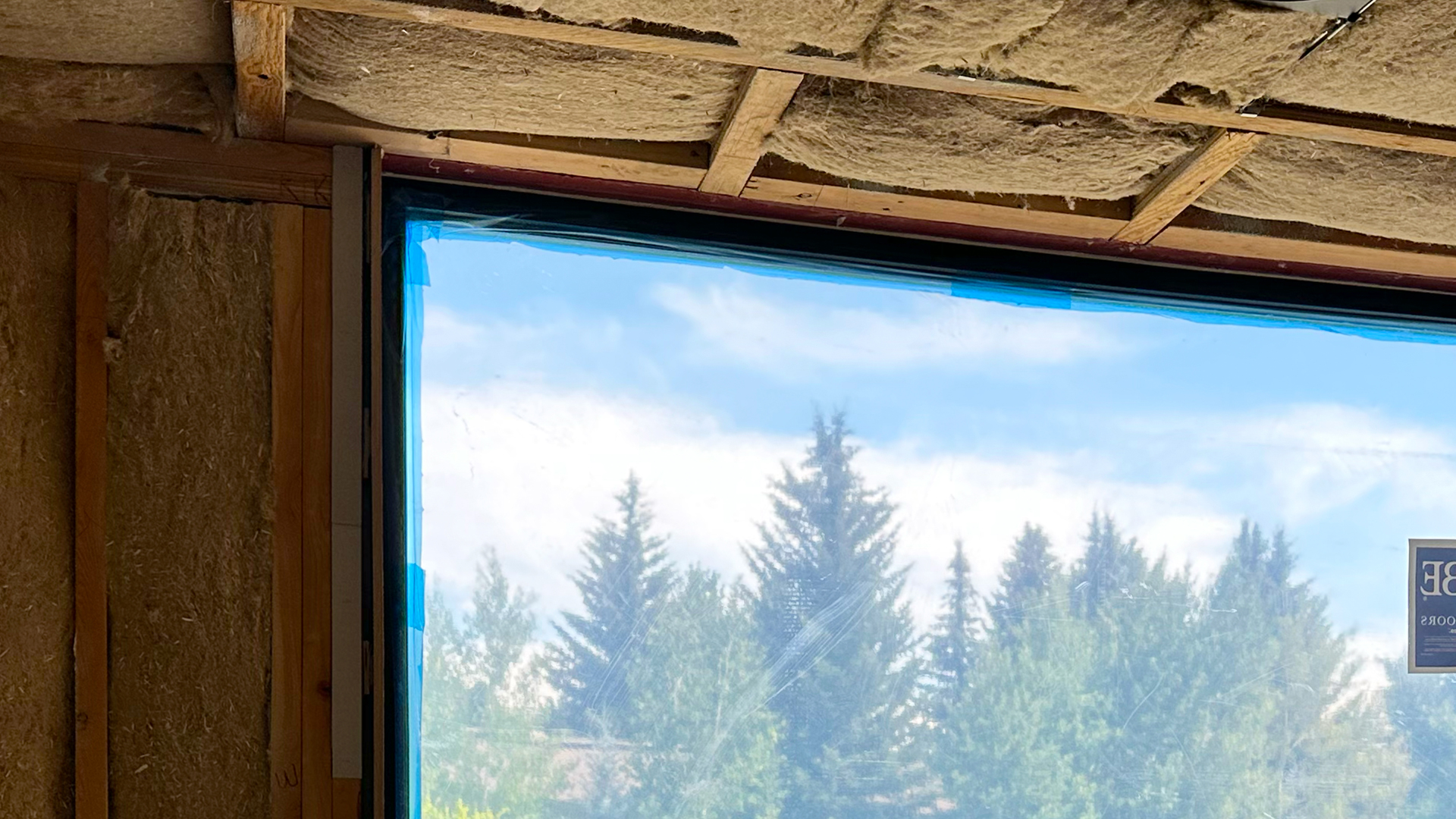
- HempWool: Cavity insulation in walls, floors, and ceilings, with acoustic performance comparable to conventional insulation in modeled assemblies.
- PlantPanel and PlantPanel X: Cavity absorbers with a slight low-frequency edge, and a development path toward exposed room absorbers.
- FiberPad: Resilient underlayment for impact sound on concrete, CLT, and timber floors, used as part of a complete floor build-up.
How to specify hemp insulation for acoustics
- Define the problem. Identify whether you are solving airborne isolation, room reverberation, impact noise, or a combination.
- Specify the full assembly. Name every layer, connection, and seal, not just the insulation.
- Separate measured from modeled data. Label impedance-tube values, R&D measurements, and calculated ratings for what they are.
- Review frequency response. Single-number ratings can hide weak low-frequency performance.
- Control junctions. Detail flanking paths at walls, floors, and penetrations.
- Match documentation to project stage. Modeled data supports early design. Where ratings are required, plan for testing and confirm requirements with the authority having jurisdiction.
Frequently asked questions
Is hemp insulation good for soundproofing?
Yes, as part of a well-designed assembly. In Leftear’s ISO 12354 model, a wall with 2″ HempWool reached STC 51, the same as an equivalent wall with conventional mineral wool. As with any insulation, the overall rating depends on mass, framing, and sealing.
What is the NRC of HempWool?
Impedance-tube testing gave indicative NRCn values of 0.55 for 2,018 g/m² HempWool and 0.69 for 2,347 g/m² HempWool. These are not ASTM C423 NRC ratings.
Can PlantPanel be used as an acoustic panel?
It shows strong potential. PlantPanel X reached an indicative NRCn of 0.77. Rated panel configurations still need defined mounting and facing details and ASTM C423 testing.
Does FiberPad improve impact sound on CLT?
In Leftear’s R&D measurements on 4″ CLT, FiberPad improved impact sound by up to 27.2 dB at 400 Hz, with smaller gains at the lowest frequencies. It has not yet been tested for a weighted ΔIIC or in an ASTM E492 assembly test.
Can an architect specify the modeled STC and IIC assemblies?
They are useful for early design and comparison, but they are advisory values with roughly ±3 points of uncertainty. Where a project requires certified ratings, plan for assembly testing and confirm requirements with the authority having jurisdiction.
Build the assembly, not just the material layer
The Leftear work shows that hemp-based materials can do the acoustic jobs specifiers ask insulation to do: fill cavities as effectively as conventional insulation, absorb sound strongly in the mid and high frequencies, and cut impact noise substantially on concrete, CLT, and timber. Good acoustic performance still comes from the whole assembly.
Planning a project with HempWool, PlantPanel, or FiberPad? Contact Hempitecture to request the Leftear technical note or discuss acoustic assemblies for your build.
References
- Leftear. TN – Hempitecture – 1.0, technical note, May 15, 2026.
- ISO 10534-2:2023. https://www.iso.org/standard/81294.html
- ASTM C423. https://store.astm.org/c0423-23e01.html
- ASTM E492. https://store.astm.org/e0492-25.html
- Vardaxis, Bard, and Wålinder. “Evaluating Laboratory Measurements for Sound Insulation of Cross-Laminated Timber Floors.” Applied Sciences, 2022. https://doi.org/10.3390/app12157642
- Ha et al. “A Study on Floor Impact Sound Insulation Performance of Cross-Laminated Timber Slabs.” Journal of the Korean Wood Science and Technology, 2023. https://www.woodj.org/archive/view_article?pid=wood-51-5-419